
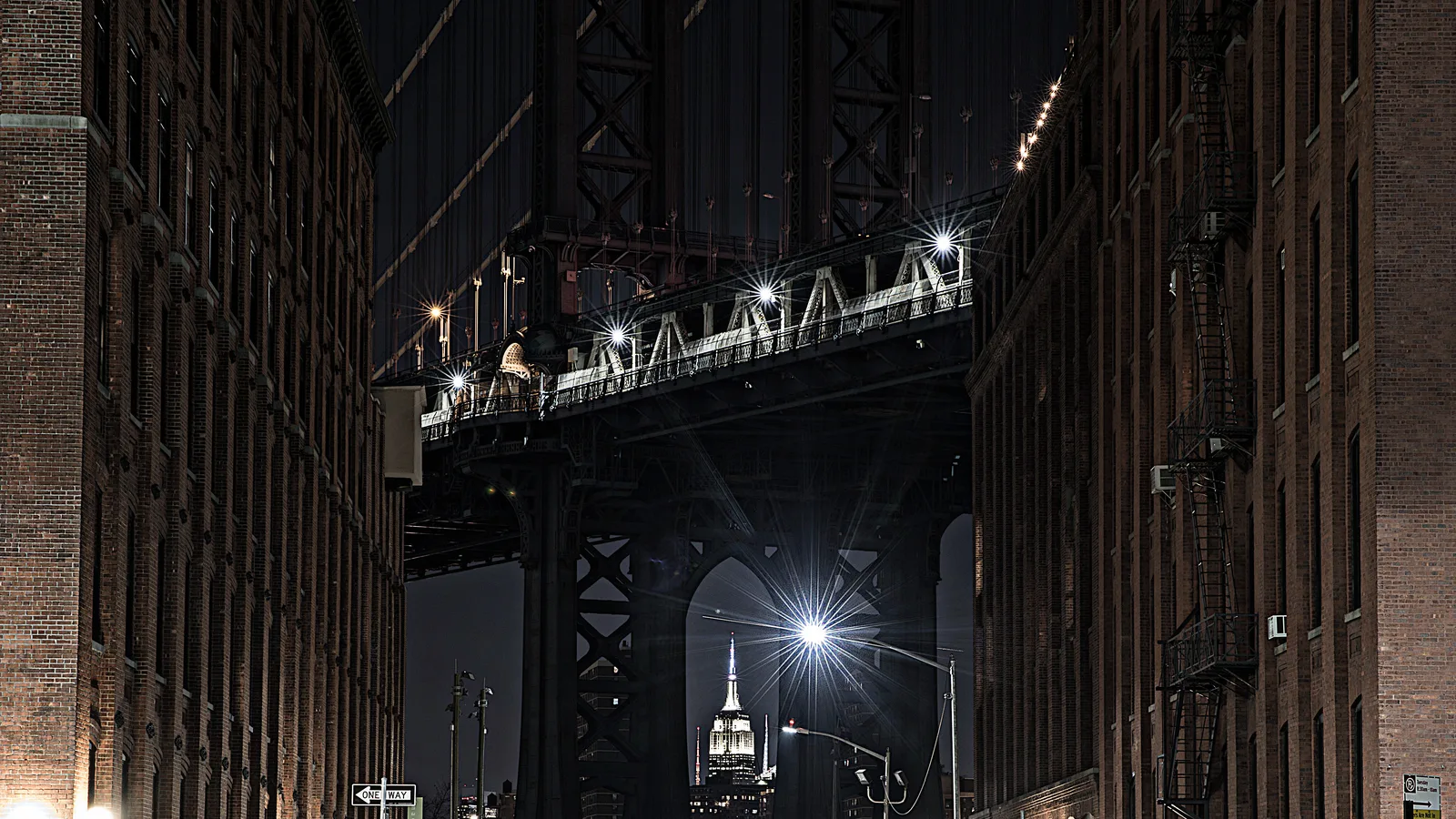
For six years, crews took DUMBO's streets apart block by block, lifted the Belgian block, rebuilt the pipes underneath and put the stones back where they came from. Along the way they kept finding things. By Team Dumbo's count, the street project turned up 2,771 artifacts, many from the early 1800s, buried under the neighborhood the bridges later made famous.
Eighteen of them are about to come out of storage. Dumbo Before the Bridges, an exhibit curated by the project's archaeologist, Mark Tweedie, opens on November 5 at the Brooklyn Public Library's Adams Street Library, 9 Adams Street, and stays up through February 28, 2027.
What came out of the ground
The city's own account of the dig describes a collection that is mostly ceramics: earthenware, stoneware and porcelain, the dishes, jugs and building pieces of a working waterfront. The rest is glass, metal, wood, stone and leather, plus animal bones, teeth and shells. A few pieces date to the late 1600s, though most fall between the mid-1800s and the mid-1900s.
The city singled out two finds as the most significant. One is a copper button, made sometime between the 1860s and 1900, stamped with the Excelsior emblem of New York State. The other is a clay smoking pipe from roughly the 1820s to the 1860s, stamped with a Liberty Eagle. When the project wrapped up, the city said it was looking for a public home for the collection. The library show is that home, at least for the winter.
Team Dumbo, the neighborhood's business improvement district, says the exhibit pairs the objects with historic photographs to show how people lived and worked along this stretch of the East River before the Brooklyn Bridge and the Manhattan Bridge were built over it.
The project that dug them up
The artifacts came out of a city capital project known by its contract number, HWKKP005. It broke ground in April 2019 and finished in December 2025, at a cost of $108 million. The Department of Design and Construction ran the work, with most of the money from the Department of Transportation and the Department of Environmental Protection.
Above ground, 26 blocks were rebuilt in cobblestone with granite curbs. Twenty-five of them had been cobblestone all along, though decades of utility work had scattered or paved over many of the stones. The 26th, Gold Street between Front and Water Streets, had been asphalt and was converted. Residents asked during planning for the old stones to stay on their own blocks, so stones that came up were stored off site and returned to the street they came from.
The project also laid 8,800 feet of smooth granite bike lanes into the cobblestone, added 114 accessible pedestrian ramps and built Pearl Street Plaza beside the Manhattan Bridge, a 2,500-square-yard granite plaza connected to the restored Archway. Underneath, it added more than three miles of new or upgraded storm sewers, sanitary sewers and water mains, which the city says will cut down on sewage reaching the harbor in heavy rain.
When the last block went in on November 19, 2025, Team Dumbo held what it called the last Belgian Block Party, and more than 400 neighbors turned out for it.
Visiting the exhibit
Adams Street Library is at 9 Adams Street, between John and Plymouth Streets, a short walk from the York Street F station and the High Street A and C station. The branch is open Monday, Wednesday and Friday from 10 a.m. to 6 p.m., Tuesday from 1 to 8 p.m., Thursday from 10 a.m. to 8 p.m. and Saturday from 10 a.m. to 5 p.m. It is closed on Sundays. Admission to the library is free.
The show runs November 5, 2026, through February 28, 2027. Team Dumbo's construction page, which carries the exhibit announcement, also has timelapse videos of each block being rebuilt, from Water Street to the Archway plaza.
Loading comments…